Military Life
SEAL Team Six F-15 Rescue in Iran 2026: The Full Story
The complete story of how SEAL Team Six and Delta Force rescued a downed F-15 pilot from Iran in April 2026 after 48 hours behind enemy lines.“
By BaseNeed Team · April 6, 2026 · 22 min read read
SEAL Team Six Combat Search and Rescue Iran Military Operations Special Operations Forces F-15 Pilot Rescue
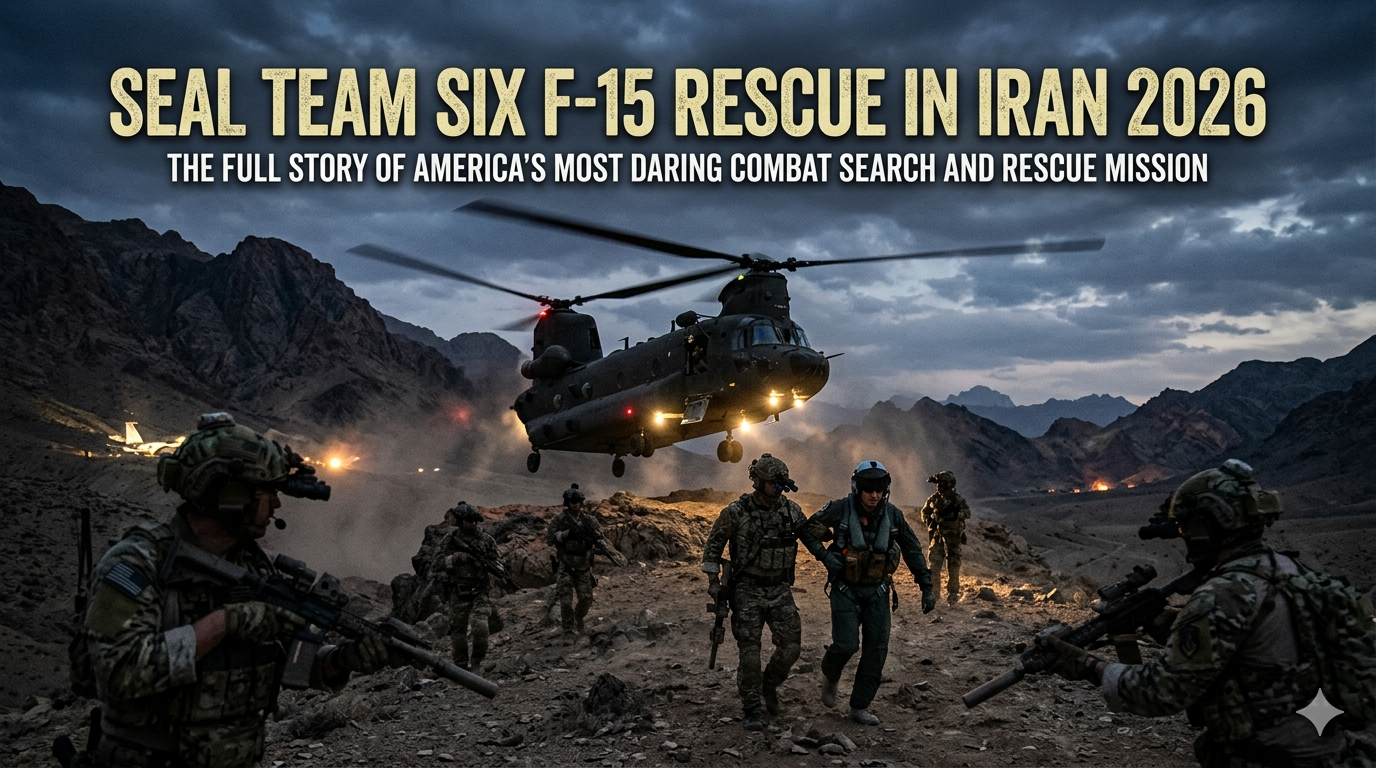
SEAL Team Six F-15 Rescue in Iran 2026: The Full Story of America's Most Daring Combat Search and Rescue Mission
By Staff Sergeant (Ret.) Marcus Webb | Military Analyst & Community Leader at BaseNeed | Former Army Ranger, 10 Years Active Duty, Three Combat Tours
On April 5, 2026, President Donald Trump called it "one of the most daring Search and Rescue Operations in U.S. History." After 48 grueling hours deep inside one of the world's most hostile territories, a wounded U.S. Air Force colonel was pulled from the mountains of Iran by an elite special operations force — the first time since the 2003 Iraq invasion that a U.S. aircraft had been shot down by enemy fire.
This is the complete story of the F-15 rescue in Iran 2026 — the crash, the faith, the hunt, the technology, the operators, and the courage that defined one of the most extraordinary military rescues in modern American history. Every member of the BaseNeed community needs to read this from start to finish.
If you want to understand how our military prepares for moments like this, read our deep-dive on SEAL Team Six: History, Training, and Missions. And if you are a veteran or active-duty service member navigating life after a deployment, check out our Military Transition Resource Hub for tools and community support.
> Key Takeaways: F-15 Rescue Iran 2026 > - F-15E Strike Eagle shot down April 3, 2026, over southwestern Iran during Operation Epic Fury > - Pilot rescued within hours on Friday — a "bold and quick snatch" under heavy enemy fire > - WSO (Weapons Systems Officer) evaded capture for 48+ hours alone in hostile mountain terrain > - SEAL Team Six (DEVGRU) and Delta Force led the second rescue deep inside Iran > - ~200 special operations soldiers, dozens of aircraft, and CIA deception ops all involved > - The WSO's faith-based radio message — "Power be to God" — nearly halted the rescue > - Israel provided critical intelligence and coordinated diversionary strikes > - Zero U.S. casualties in the final rescue operation > - Trump: "First time in military memory two U.S. pilots were rescued separately, deep in enemy territory" > - Iran used a shoulder-fired missile — described by Trump as a "lucky shot"
---
What Happened: The F-15E Shootdown Over Iran on April 3, 2026
A U.S. Air Force F-15E Strike Eagle carrying two crew members was shot down while flying over southern Iran on April 3, 2026 — the first time during the war, and the first time since the U.S. invasion of Iraq in 2003, that a U.S. aircraft had been lost to enemy fire. The jet belonged to the 48th Fighter Wing, based out of Royal Air Force Lakenheath in Suffolk, England.
Onboard were two of America's finest: a pilot and a Weapons Systems Officer (WSO) — a colonel-rank aviator with years of combat experience. These were not rookies. These were seasoned warriors doing exactly what they were trained to do.
According to President Trump, the Iranian military shot down the F-15E using a shoulder-fired missile. "They got lucky," Trump said. Iran's air defenses had been significantly degraded by the joint Israeli-American war, but a single lucky surface-to-air missile brought down the advanced fighter jet. Within minutes of the crash, the U.S. military launched its response.
The Broader Context: Operation Epic Fury
In February 2026, the United States and Israel began a series of coordinated strikes on sites and cities across Iran, starting what became known as Operation Epic Fury. The F-15E shootdown on April 3 — Day 37 of the war — marked the first manned U.S. aircraft lost to enemy fire during the entire conflict. The last time a U.S. fighter jet was shot down in combat before this incident was an A-10 Thunderbolt II during the 2003 invasion of Iraq — making this a historic and deeply alarming moment for the entire U.S. military establishment.
America was now in uncharted territory. And a warrior was behind enemy lines.
---
Phase One: Rescuing the Pilot — A Bold Daytime Snatch Under Fire
The moment the F-15E went down, U.S. forces were already in motion. The pilot and WSO ejected separately and landed miles apart in rugged Iranian mountain terrain. The pilot was recovered the same day in daylight, in what U.S. defense officials described as a "bold and quick snatch" under heavy Iranian fire.
Iranian forces fired on the rescue aircraft during this first operation. An A-10 Thunderbolt II attack aircraft and at least one HH-60 rescue helicopter were hit by Iranian fire. The A-10 pilot ejected and was subsequently recovered. The HH-60 took hits but managed to stay airborne — a testament to the robustness of American equipment and the determination of the crew.
Think about what that means. Rescue aircraft taking fire. Crews being hit. And still pressing forward. That is the American military spirit. That is what "never leave a man behind" actually looks like when bullets are flying and the easy choice is to turn back.
Pilot: rescued. One man home. Now the full focus turned to the WSO — and the situation was far more complex.
---
Phase Two: 48 Hours Behind Enemy Lines
The WSO's story is one for the history books.
The weapons systems officer was wounded after ejecting from the aircraft, but could still walk. He evaded capture in the mountains for more than a full day while the Islamic Revolutionary Guard Corps (IRGC) raced to find him in southwest Iran. After ejecting, he spent over 24 hours evading Iranian forces — hiding in a mountain crevice and hiking a 7,000-foot ridgeline with only his pistol — before SEAL Team Six arrived to extract him.
Let that sink in. Wounded. Alone. No backup. Enemy forces closing in from every direction. One pistol. A 7,000-foot mountain ridge between him and safety.
The SERE Training That Saved His Life
According to U.S. officials, the airman relied on his mandatory Survival, Evasion, Resistance, and Escape (SERE) training to avoid capture for a day and a half. SERE is not standard training. It is a deliberate psychological and physical crucible designed to prepare U.S. aircrews for exactly this scenario. Pilots learn to move without being seen, survive without supplies, navigate by instinct, and — most critically — never surrender.
Standard-issue survival beacons for U.S. aircrew transmit encrypted distress signals detectable by aircraft and satellites. The device, kept in the aircrew's survival vest, activates automatically on ejection — so even if the airman is unconscious, he can still be found. His training and his gear kept him alive. But it was his faith that kept him going.
Want to learn more about how America's special operations forces train for missions like this? Read our full guide: How SEAL Team Six Operators Are Selected and Trained.
Iran's Nationwide Hunt
Following the downing of the F-15E, Iran's IRGC cordoned off large sections of the mountainous southwestern Kohgiluyeh and Boyer-Ahmad Province. Iranian authorities — in a rare and extraordinary move — called on the general public to help find and capture the missing American soldier, offering cash rewards to any civilian who located him.
"Thousands of these savages were hunting him down," Trump said. "Even the population was looking for him. They offered people a bonus if they captured him."
One man. Wounded. Alone. Against thousands of soldiers and an entire civilian population mobilized against him. And he survived.
---
Faith Under Fire: "Power Be to God"
This is the part of the story that has moved the entire BaseNeed community — and millions of Americans across the country.
When the wounded WSO finally activated his survival radio, he did not send a standard distress code or a set of coordinates. Instead, the stranded officer broadcast a four-word declaration:
"Power be to God."
A U.S. defense official later confirmed the exact wording was "God is good." Those words almost stopped the rescue before it began.
President Trump stated that the United States initially feared the message was a trick by the Iranians — a deception designed to lure U.S. forces into a prepared ambush. "What he said on the radio sounded like something a Muslim would say," Trump told Axios. Command paused. The stakes could not have been higher: move in and risk walking into an Iranian trap, or hold back and potentially abandon a man who was alive and calling for help.
The decision was confirmed when colleagues who knew the officer personally vouched for his character: he is a man of deep faith. A defense official confirmed: "It was not completely clear early on, but we stuck with it and verified he was alive and not captured. And those who knew him said he is religious."
Command chose faith over fear. They verified. They pressed forward. And because of that decision — made under extraordinary pressure, with American lives on the line — a warrior came home.
Defense Secretary Pete Hegseth posted "God is good" on X Sunday morning after the rescue was confirmed. In his darkest hour, this man's first instinct was not panic, not despair — it was prayer. And God answered.
For more stories of faith and resilience inside our military community, visit our BaseNeed Faith & Service Series.
---
The Rescue Operation: A Multi-Domain Special Operations Masterpiece
Who Was Involved
The elite Army Delta Force and Navy SEAL Team Six were among the hundreds of special operations troops and U.S. military and intelligence personnel involved in the rescue of the U.S. Air Force colonel in Iran. Around 200 soldiers from special operations units participated, according to Trump.
| Element | Role in the Operation |
|---|---|
| SEAL Team Six (DEVGRU) | Primary ground extraction force |
| Delta Force | Support and security operations |
| CIA | Intelligence gathering and active deception campaign |
| Cyber Assets | Electronic warfare and signal disruption |
| Satellite Systems | Real-time surveillance and tracking |
| MC-130J Commando II | Operator infiltration and exfiltration |
| Pave Hawk Helicopters | Personnel recovery and close air support |
| ISR Platforms | Persistent surveillance of the WSO's location |
| Israeli Intelligence | Real-time intel sharing and diversionary strike coordination |
The CIA Deception Campaign
This is the detail that makes this operation truly extraordinary. The CIA ran active deception operations against Iranian forces — feeding false information into the Iranian intelligence system, drawing their attention away from the real extraction corridor while SEAL Team Six moved in through the mountains.
While Iranian commanders were looking in the wrong direction, America's best were already on the ground, moving toward their man with lethal precision. The operation involved a temporary forward operating base established inside Iran — a staging point deep in enemy territory used to coordinate the final extraction.
The Night Extraction
The second rescue was conducted at night. SEAL Team Six operators located the WSO in his mountain crevice, secured him, and extracted the team without a single American casualty. Two U.S. transport aircraft used in the operation were deliberately destroyed on the ground to prevent their capture and exploitation by Iranian forces — a calculated sacrifice that demonstrates the discipline and professionalism of the entire force.
Zero American lives lost. One American warrior brought home.
---
Israel's Critical Role in the F-15 Rescue
This rescue was also a story of alliance in action — and it is a story worth telling clearly.
Israeli sources confirmed that Israel offered intelligence support and postponed planned strikes on Iran to avoid interfering with the search-and-rescue mission. Throughout the tense 48-hour window, IDF Chief of Staff Eyal Zamir and U.S. Central Command Commander Admiral Brad Cooper remained in direct contact. The IDF also coordinated with U.S. forces to launch strategic diversionary strikes designed to pull Iranian units away from the crash site.
Israeli Prime Minister Benjamin Netanyahu publicly praised the mission: "I am deeply proud that our cooperation on and off the battlefield is unprecedented, and that Israel could contribute to saving a brave American warrior." Netanyahu confirmed he spoke with Trump to congratulate him on the "perfectly executed American mission."
Trump acknowledged Israel's contribution, calling them "good partners" and adding: "We are like a big brother and little brother."
This is what real alliances look like. Not summits and press releases — real-time intelligence shared at the highest levels of two militaries, with a man's life on the line.
---
The Technology That Brought Him Home
Survival Beacons and Encrypted Communication
Standard-issue survival beacons for U.S. aircrew can continuously transmit encrypted, precise military coordinates, data, and short messages to friendly forces via military satellites. Devices like the Boeing Combat Survivor Evader Locator give off homing signals that allow rescue helicopters to zero in on the aviator. They can handle jamming, electronic interference, and full water immersion — and their batteries are designed for extended operations exactly like this one.
Without this technology, the WSO would have been invisible in thousands of square miles of hostile mountain terrain. The beacon in his survival vest — activated the moment he ejected — was his lifeline to the most powerful military machine in history.
Intelligence, Surveillance, and Reconnaissance
Officials described the terrain where the flight crew ejected as "exceptionally difficult" and confirmed that "exquisite capabilities" were used to pinpoint the airman's position. High-resolution satellite imagery, signals intelligence, and a full array of classified surveillance systems were focused on one man in one patch of Iranian mountain — tracking him, protecting him from above while he fought his way toward rescue on the ground.
---
Full Timeline: From Shootdown to Safe Recovery
| Date & Time | Event |
|---|---|
| Friday, April 3 — Night | F-15E Strike Eagle shot down over Kohgiluyeh Province, southwestern Iran |
| Friday, April 3 — Hours after crash | Pilot rescued in daylight — "bold and quick snatch" under heavy Iranian fire |
| Friday, April 3 | A-10 Thunderbolt and HH-60 helicopter hit by Iranian fire during first rescue |
| Friday evening — Saturday | WSO evades thousands of Iranian troops alone in mountains for 48+ hours |
| Saturday | WSO transmits "Power be to God" / "God is good" over survival radio |
| Saturday | U.S. command debates authenticity of signal — fears Iranian trap |
| Saturday night | SEAL Team Six + Delta Force execute final rescue from temporary base inside Iran |
| Saturday night | Two U.S. transport aircraft destroyed on ground to prevent Iranian capture |
| Early Sunday, April 5 | Trump announces successful rescue via social media |
| Sunday morning, April 5 | Defense Secretary Hegseth posts "God is good" on X |
| Sunday, April 5 | Netanyahu congratulates Trump; confirms Israeli intelligence support |
---
What This Mission Means for the BaseNeed Community
A Record That Stands Alone
Trump described the mission as "the first time in military memory that two U.S. pilots were rescued, separately, deep in enemy territory." Read that again. Not one rescue — two. On two separate days. In one of the most hostile environments on earth. Both successful. No American lives lost in either extraction. This is the product of decades of investment in training, technology, and the warrior ethos that defines the U.S. military.
What "Never Leave a Man Behind" Actually Costs
It is easy to say "never leave a man behind." It is another thing entirely to mean it when it costs you aircraft, risks hundreds of lives, and requires you to penetrate the most dangerous airspace on the planet. At least one Black Hawk helicopter was hit. Two transport planes were sacrificed. Assets were lost. Iron was destroyed. But the man was not abandoned. That is the American military creed made flesh.
The Human Cost of Operation Epic Fury
The latest data from Operation Epic Fury reports 365 U.S. troops wounded in action and 13 killed. Every number is a name. Every name is a family. The BaseNeed community exists because we understand that these are not statistics — they are our brothers and sisters, our neighbors, our children.
If you are a Gold Star family member or know someone affected by the ongoing conflict, our BaseNeed Support Network is here for you 24/7.
---
Frequently Asked Questions: F-15 Rescue Iran 2026
What is the F-15 rescue in Iran 2026?
The F-15 rescue Iran 2026 refers to a two-phase U.S. military combat search-and-rescue operation conducted on April 3–5, 2026, after a U.S. Air Force F-15E Strike Eagle was shot down over southwestern Iran during Operation Epic Fury. Both crew members — the pilot and the Weapons Systems Officer — were successfully rescued by U.S. special operations forces in separate operations, with zero American casualties in either extraction.
Who rescued the F-15 pilot in Iran?
The first rescue — the pilot — was conducted by U.S. military helicopter crews in a daylight operation under heavy Iranian fire. The second rescue — the WSO — was led by Navy SEAL Team Six (DEVGRU) and Army Delta Force, supported by approximately 200 special operations soldiers, dozens of aircraft, CIA deception operations, and Israeli intelligence.
How long was the F-15 WSO behind enemy lines in Iran?
The Weapons Systems Officer evaded capture for more than 48 hours in the mountainous Kohgiluyeh and Boyer-Ahmad Province of southwestern Iran. He was wounded on ejection but still able to walk. He survived by hiding in a mountain crevice, hiking a 7,000-foot ridgeline, and relying on his SERE training throughout.
What did the F-15 pilot say on the radio after ejecting over Iran?
After ejecting from the aircraft, the WSO transmitted the message "Power be to God" over his survival radio. A U.S. defense official later confirmed the exact phrasing as "God is good." The message initially raised alarm among U.S. command, who feared it might be an Iranian deception to lure rescue forces into a trap. Colleagues who knew the officer confirmed he was a deeply religious man, and the rescue proceeded.
Was the F-15 rescue the first time SEAL Team Six rescued a pilot from Iran?
Yes. This was an unprecedented operation — described by President Trump as "the first time in military memory that two U.S. pilots were rescued, separately, deep in enemy territory." It was also the first time a U.S. manned aircraft was shot down in combat since an A-10 Thunderbolt II was lost during the 2003 Iraq invasion.
Did Israel help rescue the F-15 pilot in Iran?
Yes. Israel played a significant supporting role in the rescue mission. Israeli intelligence provided real-time information to U.S. forces, the IDF postponed planned strikes on Iran to avoid interfering with the operation, and Israeli and U.S. forces coordinated diversionary strikes designed to draw Iranian units away from the crash site. IDF Chief of Staff Eyal Zamir and CENTCOM Commander Admiral Brad Cooper remained in direct contact throughout the 48-hour operation.
Were any U.S. service members killed in the F-15 rescue operation?
No. Despite fierce Iranian resistance — including fire on rescue aircraft during the first operation and the destruction of two U.S. transport planes during the second — zero U.S. service members were killed in either rescue. One A-10 pilot was hit and subsequently recovered. The SEAL Team Six-led second extraction was completed without a single American casualty.
What is Operation Epic Fury?
Operation Epic Fury — also referred to as Operation Roaring Lion — is the ongoing U.S.-Israeli military campaign against Iran that began in February 2026. As of April 2026, the operation has resulted in 365 U.S. troops wounded in action and 13 killed. The F-15E shootdown on April 3 was the first manned U.S. aircraft lost to enemy fire during the conflict.
How did the U.S. find the downed airman in Iran?
U.S. forces used a combination of encrypted survival beacon signals from the WSO's standard-issue vest, high-resolution satellite imagery, signals intelligence, and classified surveillance systems to track the airman's position across the rugged Iranian mountain terrain. Officials described the capabilities used as "exquisite."
What is SERE training and why did it matter in this rescue?
SERE stands for Survival, Evasion, Resistance, and Escape. It is mandatory training for all U.S. aircrew designed to prepare them for exactly this scenario — being shot down in hostile territory. The WSO's SERE training allowed him to evade thousands of Iranian troops for over 48 hours, navigate without support, and stay calm and functional despite his injuries until rescue arrived.
---
What to Do Next: How the BaseNeed Community Can Support Our Troops
Reading this story is the first step. But the BaseNeed community is built on action — and there is plenty you can do right now to show up for the men and women who serve.
Stay Informed on Operation Epic Fury
The conflict in Iran is ongoing. Our troops are still deployed, still in danger, and their families are still waiting at home. Bookmark the BaseNeed News Hub for daily updates on Operation Epic Fury, troop movements, and policy developments affecting the military community. Do not rely on mainstream headlines alone — we give you the ground-level perspective.
Support Military Families Directly
Behind every deployed service member is a family carrying a weight most civilians will never fully understand. If you know a military family in your community, show up for them. Meals, childcare, a phone call, a knock on the door — the small things matter more than you know. Visit our Community Support Board to connect with families who need help right now.
Share This Story
The mainstream media covers this mission in headlines. The BaseNeed community tells the full story — the faith, the training, the technology, the sacrifice, and the brotherhood that made it possible. Share this article with every veteran, active-duty service member, and military family member you know. Use the hashtags #NeverLeaveAManBehind, #SEALTeamSix, and #Baseneed to amplify the message.
Connect With Our Veteran Network
If you are a veteran or currently serving and want to connect with a community that truly understands your experience, join the BaseNeed network at baseneed.com. Whether you are navigating a PCS move, a military transition, or just looking for people who get it — we are here. Read our Military Transition Guide and our PCS Financial Strategy Guide to get the most out of your service.
Honor the Fallen
365 troops wounded. 13 killed. These are not abstractions. Visit our Honor Wall to recognize the service and sacrifice of every American who has given something in Operation Epic Fury. Leave a message. Say a name. It matters.
---
Sources & Resources
The following sources were used in the research and writing of this article. We encourage every BaseNeed reader to go deeper on this story.
Primary News Sources
- Axios — Exclusive Trump interview on the F-15 rescue and radio transmission: axios.com
- CNN — Day 37 live coverage and executive summary of the rescue operation: cnn.com
- Military Times — Breaking coverage of the rescue and Operation Epic Fury: militarytimes.com
- Military.com — F-15 shootdown and search operation details: military.com
- The Jerusalem Post — Israeli intelligence role and technology breakdown: jpost.com
- Al Jazeera — Full what-we-know breakdown including A-10 and Iranian response: aljazeera.com
- The Washington Post — U.S. military and CIA coordination reporting: washingtonpost.com
- Time Magazine — How the airman was rescued from a mountain crevice: time.com
- Army Recognition — SEAL Team Six operational role analysis: armyrecognition.com
- Wikipedia — 2026 U.S. pilot rescue operation in Iran: en.wikipedia.org
Official U.S. Military & Government Resources
- U.S. Department of Defense — Official news and briefings: defense.gov
- U.S. Air Force — F-15E Strike Eagle aircraft information: af.mil
- U.S. Special Operations Command (SOCOM) — Special operations force information: socom.mil
- Military OneSource — Support for military families during deployment: militaryonesource.mil
BaseNeed Internal Resources
- SEAL Team Six: History, Training, and Missions
- How SEAL Team Six Operators Are Selected and Trained
- Operation Epic Fury: Everything the BaseNeed Community Needs to Know
- Faith & Service: Stories From the Military Community
- BaseNeed Military Transition Resource Hub
- PCS Financial Strategy Guide 2026
- BaseNeed Support Network for Military Families
- BaseNeed Community Honor Wall
---
Final Thoughts: Stand Tall, BaseNeed Community
The F-15 rescue in Iran 2026 is more than a military headline. It is a testament to the values that every BaseNeed community member lives by every single day. Here is what this mission proved:
Faith matters. When everything else was stripped away, this officer's first instinct was prayer. And it brought him home.
Training saves lives. The hours of SERE training — the discomfort, the exhaustion, the repetition — are the difference between life and death when the moment comes.
Alliances are real. This mission succeeded because two nations trusted each other enough to share their most sensitive intelligence at the highest levels of command.
America keeps its promises. "Never leave a man behind" is not a slogan. It is a commitment that this mission proved, once again, in blood and iron.
The war continues. Our troops are still in harm's way. Honor their service by staying informed, staying connected, and showing up for each other the way our military shows up for its people.
God is good. God bless our troops. God bless America. 🇺🇸🦅
---
Follow the latest military news and connect with our community at @baseneed and baseneed.com. Drop a comment below and show your support for our troops.
#USA #MilitaryStrong #SEALTeamSix #NeverLeaveAManBehind #Baseneed #AmericanHeroes #F15Rescue #OperationEpicFury #NavySEALs #DeltaForce #FaithUnderFire
Read Full Article on BaseNeed →
Related Military Life guides
- → Basic Allowance for Housing (BAH): The Complete 2026 Guide to Rates, Dependents & How It's Calculated — 13 min read read
- → Military Car Buying: The Complete 2026 Guide to Auto Loans, SCRA Protections & Avoiding Dealer Traps — 14 min read read
- → Military Spouse Income During Deployment: Stack Pay, Budget the Extra & Add Flexible Work (2026) — 8 min read read
- → Military Discount Flights: The Complete 2026 Guide to Airline Military Discounts, Free Bags & Cheap Fares — 14 min read read
- → Blended Retirement System: The Complete 2026 Guide to BRS, TSP Matching & Your Military Retirement — 14 min read read
- → Basic Training Graduation Gifts: 45+ Ideas by Branch, Budget & What Recruits Actually Want (2026) — 13 min read read