Military Life
Space-A Flights: The Complete 2026 Guide to Flying (Almost) Free on Military Aircraft
Space-A flights let service members, retirees, families and 100% disabled veterans fly nearly free on military aircraft. Here is exactly how the 2026 system works — categories, sign-up, terminals, and mistakes to avoid.
By BaseNeed Team · July 3, 2026 · 13 min read read
space-a flights space-a travel military travel benefits air mobility command disabled veterans
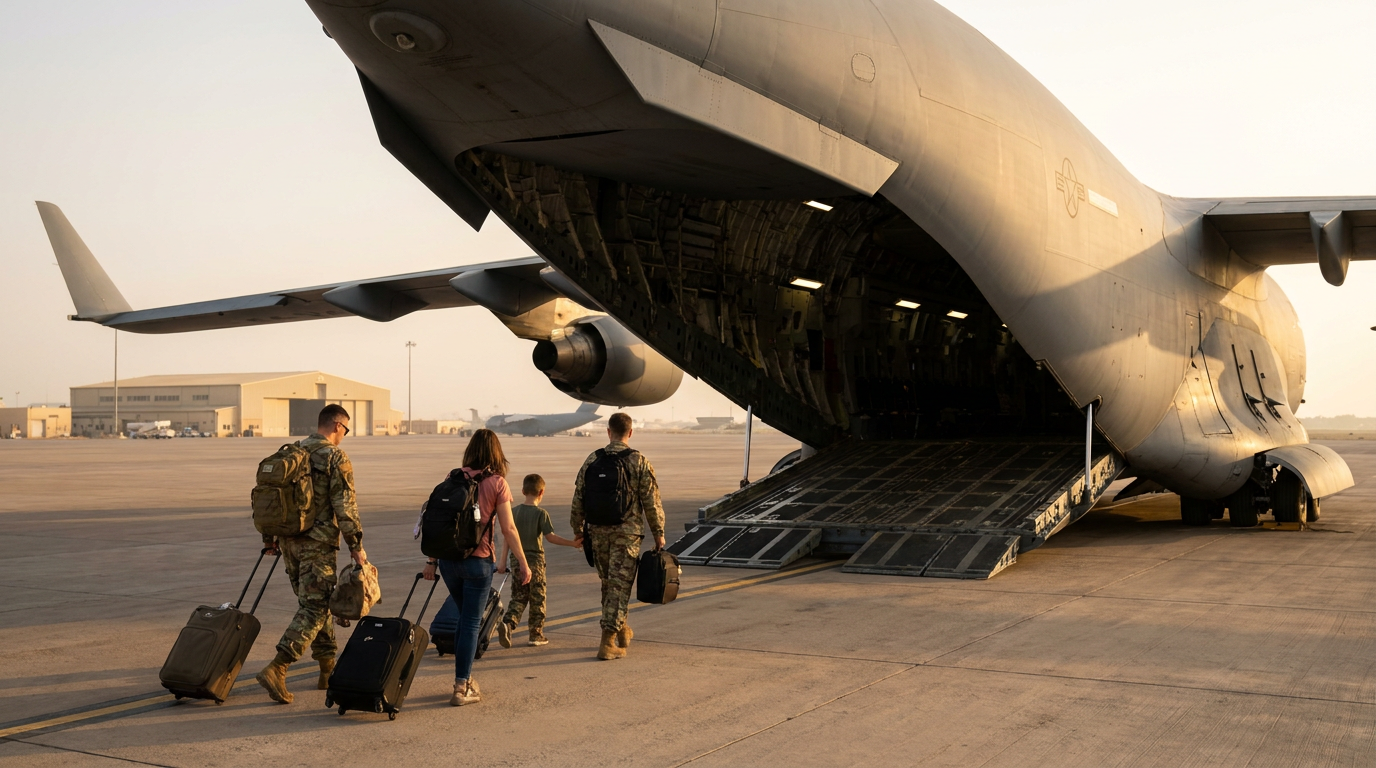
Space-A Flights: The Complete 2026 Guide to Flying (Almost) Free on Military Aircraft
By the BaseNeed Team — military family resources, updated 2026
Space-A flights are one of the best-kept "open secrets" in the military community: if you're eligible, you can hop on a military aircraft — a C-17 headed to Germany, a KC-135 bound for Hawaii, or a Patriot Express rotator to Japan — for little or nothing out of pocket. Space-Available travel (everyone calls it "Space-A" or "taking a hop") fills unused seats on Department of Defense aircraft with service members, retirees, families, and — since the FY2019 NDAA — certain disabled veterans. Done right, Space-A can save a family of four several thousand dollars on a single overseas trip. Done wrong, it can leave you stranded in a passenger terminal for three days watching flights cancel.
This guide covers everything: who can fly, exactly how to sign up, how the six priority categories work, the rules for veterans, what Air Mobility Command terminals expect from you, what to pack, and the mistakes that get first-timers burned. By the end, you'll know whether Space-A fits your next trip — and how to actually get on the plane.
> Affiliate disclosure: This article contains Amazon affiliate links. If you buy through them, BaseNeed may earn a small commission at no extra cost to you. It helps us keep resources like this free for the military community.
What Are Space-A Flights and How Do They Work?
Space-A stands for Space-Available travel. When a military aircraft flies a scheduled mission — cargo runs, training flights, passenger rotators — any seats not needed for duty passengers or cargo can be released to eligible travelers. The Air Mobility Command (AMC) manages most of this system through roughly 50+ passenger terminals worldwide, from Baltimore-Washington (BWI) and Travis AFB to Ramstein, Yokota, and Hickam.
Here's the fundamental deal you're making:
The military gets nothing from you except a filled seat, and you get transportation that costs between $0 and roughly $40 in fees. In exchange, you accept zero guarantees. Missions change, seats disappear when cargo priorities shift, and you can be bumped at any point — even after boarding. Space-A is a privilege, not an entitlement, and the system is built around one rule: mission first, passengers second.
That's why experienced Space-A travelers follow the golden rule: never fly Space-A when you absolutely must be somewhere by a specific date. Fly it when you have flexible time, a backup plan, and a sense of adventure. Retirees with open calendars and families on block leave do great. Anyone flying to a wedding that starts in 48 hours does not.
The aircraft themselves range widely. You might ride the Patriot Express ("the rotator") — a chartered commercial airliner with normal seats, flight attendants, and meals — or a C-17 Globemaster III with sidewall jump seats, earplugs, and a cargo pallet as your seatmate. Both count. Both get you there.
Who Can Fly Space-A: The Six Eligibility Categories
Your category determines your boarding priority. When 80 people compete for 30 seats, the terminal calls categories in order — Cat I first, Cat VI last — and within each category, by the date and time of your sign-up. Understanding this table is understanding Space-A:
Space-A Travel Priority Categories Compared (2026)
| Category | Who It Covers | Typical Use Case | Priority |
|---|---|---|---|
| Cat I | Emergency leave travelers | Immediate family emergency | Highest |
| Cat II | Sponsors on Environmental and Morale Leave (EML) and accompanying dependents | Families stationed OCONUS taking EML | Very high |
| Cat III | Service members on ordinary leave; house-hunting permissive TDY; dependents of deployed members (with letter); Medal of Honor recipients | Active duty taking leave — the workhorse category | High |
| Cat IV | Unaccompanied dependents of members deployed 30+ consecutive days; DoDEA teachers (summer) | Spouse flying "home" during a deployment | Medium |
| Cat V | Permissive TDY (non-house-hunting), students, unaccompanied dependents of members stationed OCONUS | Command-sponsored college students | Low |
| Cat VI | Retirees with ID card, authorized Reserve/Guard members, and eligible disabled veterans | The classic retiree "hop" | Lowest |
A few details that matter more than people expect. First, active duty must be on leave or pass status the entire time — from sign-up validation through travel. Second, dependents cannot fly Space-A alone within the continental United States in most cases; unaccompanied dependent travel is generally tied to overseas locations and deployment situations, and command sponsorship letters are often required. Third, Reserve and Guard members travel CONUS and to/from U.S. territories in Cat VI with a valid ID and the correct status documentation; once they're receiving retired pay, they gain retiree privileges.
If you're PCSing overseas soon and wondering how your family's travel entitlements interact with all of this, our 2026 PCS Season Survival Guide breaks down official travel versus Space-A leisure travel, and our PCS move to Germany guide covers the Patriot Express specifically.
Space A Flights for Veterans
This is the question we get most often, so let's be precise, because the internet is full of wrong answers.
Most veterans cannot fly Space-A. Separating from the military with an honorable discharge does not, by itself, grant Space-A privileges. The benefit belongs to retirees (20+ years, or medically retired, holding a blue/Next-Gen retiree ID card) and to one specific veteran group added by Congress.
The John S. McCain National Defense Authorization Act for Fiscal Year 2019 extended Space-A eligibility to veterans with a permanent service-connected disability rated as total (100%). If that's you, you travel in Category VI, the same priority as retirees. You'll need your Veteran Health Identification Card (VHIC) showing "100% PERMANENT AND TOTAL SERVICE CONNECTED" (or documentation from the VA confirming the rating) to sign up and board.
Key limitations every eligible veteran should know before showing up at a terminal:
Travel is authorized within the continental United States and directly between CONUS and Alaska, Hawaii, and U.S. territories (Puerto Rico, Guam, American Samoa, and the U.S. Virgin Islands). Overseas travel to foreign countries under this authority is restricted — foreign clearance rules, status-of-forces agreements, and command policies apply, and most eligible veterans plan CONUS-and-territory trips for exactly this reason. Dependents of these veterans are not eligible — the authority covers the veteran only. And as Cat VI travelers, you board last, so route flexibility matters even more for you than for everyone else. Always verify the current policy on the AMC Travel Site before planning, because implementation details are updated periodically.
Space A Flights for 100 Disabled Veterans: Documents and Sign-Up
Because "space a flights for 100 disabled veterans" is searched thousands of times a year, here's the practical checklist for that exact traveler, start to finish.
**Step 1 — Confirm your rating is permanent and total. A 100% rating that is temporary, or based on Individual Unemployability (TDIU), does not qualify under the statute. Your VA rating decision letter states whether the rating is permanent. If you're unsure, request a benefit summary letter through VA.gov.
Step 2 — Get the VHIC. Enroll in VA health care and request a Veteran Health Identification Card at your VA medical center. The card must display your 100% P&T status. This is your boarding document — a DD-214 alone will not work at the counter.
Step 3 — Sign up remotely. Email the passenger terminals you might use (each terminal lists its Space-A email on the AMC Travel page and its terminal Facebook page) with your name, category (VI), and desired destinations. Your sign-up stays active for 60 days.
Step 4 — Show up flight-ready. Marked-present travelers need government-issued photo ID, the VHIC, and — for any territory or OCONUS-adjacent travel — a passport is strongly recommended. Bring enough funds to buy a last-minute commercial ticket home if flights dry up; this is non-negotiable advice for Cat VI travelers.
Step 5 — Be realistic about seasons. Summer PCS season (June–August) and holidays flood terminals with higher-category travelers. The best Cat VI months are typically late September through early November and late January through April.
How to Sign Up for Space-A Travel: Step by Step
The sign-up process is the same core sequence for every category, and you can do almost all of it before you ever leave your house.
1. Confirm eligibility and documents. ID card (CAC, dependent ID, retiree ID, or VHIC), leave paperwork for active duty, command sponsorship or deployment verification letters where required, and passports for OCONUS destinations (plus visas where applicable — check the DoD Foreign Clearance Guide rules for your destination).
2. Pick candidate terminals and routes. You're not booking a flight; you're registering interest at specific terminals. Sign up at several — your origin terminal plus alternates. East Coast travelers heading to Europe typically register at BWI, Dover, McGuire (JB MDL), and Charleston; West Coast Pacific travelers use Travis, Seattle (SeaTac AMC), and March.
3. Sign up remotely. Email each terminal's Space-A inbox with your name, category, ID/leave info, number of travelers, and up to five country destinations (pro tip: make one of them "ALL" to keep options open). Active duty can sign up the moment leave starts, not before. Your date-time stamp of sign-up sets your place in line within your category.
4. Watch the 72-hour flight schedules. Terminals post rolling 72-hour departure schedules on their web pages, Facebook pages, and the AMC app. Schedules shift constantly — check the night before and the morning of.
5. Mark yourself present and make roll call. On travel day, appear at the counter, show documents, and "mark present." Then wait for roll call (usually 2–3 hours before departure), when the terminal announces available seats and calls names by category and sign-up date. Miss roll call and you miss the flight, no matter how early you signed up.
6. Process, board, fly. Selected travelers check bags (generally two pieces, up to 70 lbs each per person, with family pooling allowed on many aircraft), pay any fees for commercial-contract flights, and board. On gray-tail military aircraft, expect earplugs, jump seats, cold cabins, and one of the most memorable flights of your life.
Air Mobility Command Space A Travel: Terminals and Routes That Actually Move
Not all terminals are equal. Space-A success is mostly about starting where the missions are. These are the consistently busiest AMC passenger terminals and what they're known for:
Best AMC Passenger Terminals for Space-A Flights (2026)
| Terminal | Region | Frequent Destinations | Notes |
|---|---|---|---|
| BWI (Baltimore) | East Coast | Ramstein, Rota, Mildenhall | Patriot Express hub to Europe |
| Dover AFB | East Coast | Germany, Spain, Azores | Heavy cargo missions, frequent seats |
| JB Charleston | Southeast | Europe, Caribbean, CONUS | C-17 home base |
| Travis AFB | West Coast | Hickam, Yokota, Guam | Gateway to the Pacific |
| Seattle (SeaTac AMC) | Northwest | Yokota, Osan, Elmendorf | Patriot Express to Pacific |
| JB Hickam | Hawaii | CONUS, Guam, Japan, Australia | High competition, huge variety |
| Ramstein AB | Europe | CONUS, UK, Italy, Spain | Europe's Space-A crossroads |
| Yokota AB | Pacific | CONUS, Korea, Guam, Singapore | Pacific hub with daily activity |
If Ramstein is in your plans, read our Ramstein Air Base guide first — the passenger terminal there is one of the busiest in the system, and the surrounding KMC area is easy to explore even if you get stuck for a day or two.
One more AMC-specific tip: follow the terminal Facebook pages. They post schedules, seat releases, and roll-call results daily, and terminal staff often answer questions in the comments. It remains the single best real-time information source in the Space-A world.
What to Pack for a Space-A Flight
Space-A packing has two jobs: survive a cold, loud cargo aircraft, and survive a possible 48-hour terminal delay. Seasoned hoppers pack the same core kit every time.
Wear warm layers even in July — C-17 and C-130 cabins run cold at altitude, and a packable down jacket plus wool socks make the difference between sleeping and shivering. Bring earplugs or noise-cancelling headphones (gray tails are loud), snacks and an empty water bottle (box meals are sometimes sold for a few dollars, sometimes nonexistent), a power bank sized for a long delay, and a compact sleeping setup for terminal floors — many veteran travelers carry a lightweight camping pad or travel blanket for exactly this reason.
> Popular pick: A carry-on-size travel backpack keeps you mobile when seats release at the last second and checked-bag time is tight. View on Amazon
> Popular pick: A high-capacity power bank plus noise-cancelling earbuds is the classic Space-A survival combo for terminal waits and loud cargo cabins. View on Amazon
Documents ride in a chest pouch or organizer, never in checked bags: IDs, leave papers, passports, sponsorship letters, and printed copies of everything digital. Terminals lose Wi-Fi; paper doesn't crash.
How Much Do Space-A Flights Cost?
Space-A travel on military aircraft is free. The only money that changes hands is on commercial-contract missions — primarily the Patriot Express — where travelers pay small fees (head tax and inspection fees, typically in the $20–$40 range per person for international segments). Meals aboard some flights cost a few dollars.
The real costs of Space-A are indirect, and honest budgeting includes them: lodging while you wait (base lodging or hotels near the terminal), rental cars or rideshares between alternate terminals, food during delays, and the emergency commercial airfare fund — enough to fly your whole family home commercially if seats never materialize. A good rule: if you couldn't absorb a full-price one-way ticket per person, don't start the trip. For a family weighing Space-A savings against their broader budget, our 2026 military pay chart guide and the BAH calculator help frame what the trip actually costs against household cash flow, and stacking military discounts on lodging and rental cars during delays takes real sting out of the waiting game.
Common Space-A Mistakes to Avoid
Treating it like an airline. The number one mistake. No seat exists until roll call, and no seat is safe until wheels-up. Plan buffer days on both ends — three days minimum for popular routes, more in summer.
Signing up too late — or thinking sign-up expires quickly. Your sign-up is valid for 60 days (or until your leave ends, for active duty). Signing up the day your leave starts, weeks before travel, costs nothing and puts you ahead of everyone who signed up at the counter.
Flying into a dead-end.** Getting to Hawaii or Europe is often easier than getting back. Before you fly outbound, study return mission frequency from your destination. Ramstein, Yokota, and Hickam have steady returns; smaller terminals may see one CONUS-bound flight a week.
Ignoring passport and clearance rules. A military ID gets you on the plane; it does not get you into a foreign country. Every family member needs a passport for OCONUS leisure travel, and some destinations have additional entry requirements.
Bringing pets. With narrow exceptions on PCS Patriot Express travel, pets cannot fly Space-A. If your trip involves the family dog, you're looking at commercial options — our PCS with pets guide covers what actually works.
Showing up undocumented. Leave papers not signed, dependent ID expired, missing command sponsorship letter — terminals cannot waive documentation. Check every document a week before travel.
Space-A With Family: Kids, Categories, and Sanity
Traveling Space-A with children is completely doable — thousands of military families do it every summer — but the math changes. You need seats for everyone at the same roll call, which makes large families harder to seat on tight missions; missions with 40+ released seats (Patriot Express, C-17 passenger runs) are your friend. Dependents travel in their sponsor's category when accompanied, and command-sponsored dependents stationed overseas get meaningful priority on EML (Cat II) — one of the best-value benefits of an OCONUS assignment.
Build your trip around kid-resilient logistics: base lodging within walking distance of the terminal, a car seat that you're willing to gate-check, one backpack of entertainment per child, and a hard rule that if seats don't materialize in X days, you execute the commercial backup. Families who frame the terminal wait as part of the adventure — most bases have parks, pools, and bowling alleys within a mile — consistently report the best experiences.
Key Takeaways
- Space-A fills unused seats on DoD aircraft for eligible travelers at essentially zero cost — but with zero guarantees, so never fly it against a hard deadline.
- Your priority category (I–VI) plus your sign-up date-time decides whether you get a seat; active duty on leave travel Cat III, retirees and eligible veterans Cat VI.
- Veterans qualify only with a 100% permanent and total service-connected rating (FY2019 NDAA), travel Cat VI with a VHIC, without dependents, primarily CONUS and U.S. territories.
- Sign up remotely by email at multiple terminals the moment you're eligible — the sign-up lasts 60 days and costs nothing.
- Budget for delays: lodging, food, and a full commercial-airfare backup fund are part of every smart Space-A plan.
Frequently Asked Questions
Are Space-A flights really free? Yes — travel on military aircraft costs nothing. Commercial-contract flights like the Patriot Express charge small fees, typically $20–$40 per person for international segments. Your real costs are lodging, food, and backup plans during delays.
Can 100% disabled veterans bring spouses on Space-A flights? No. The FY2019 NDAA authority covers only the veteran with a 100% permanent and total service-connected rating. Dependents of these veterans are not eligible, unlike dependents of retirees, who may fly when accompanied by their sponsor.
How long is a Space-A sign-up valid? 60 days from sign-up, or until your leave ends for active duty travelers, whichever comes first. You can re-sign immediately when it lapses, but your new date-time stamp puts you behind earlier sign-ups.
Can I fly Space-A within the United States? Yes. CONUS-to-CONUS missions fly daily, and retirees, Guard/Reserve, and eligible disabled veterans use them constantly. Competition is often lower than on glamour routes to Europe or Hawaii.
What are my chances of actually getting a seat? It depends on category, season, and route. A Cat III family in October flying Dover-to-Ramstein has excellent odds; a Cat VI solo traveler in July competing for Hickam seats may wait days. Flexibility across terminals and dates is the single biggest predictor of success.
What to Do Next
- Confirm your eligibility category and gather documents (ID/VHIC, leave papers, passports).
- Email sign-up requests to 3–5 candidate terminals today — it's free and lasts 60 days.
- Follow those terminals' Facebook pages and start watching the 72-hour schedules.
- Build your buffer: block flexible dates, book refundable base lodging, and fund your commercial backup.
- Pack the terminal survival kit — layers, power bank, earplugs, snacks — and go take the hop.
More From BaseNeed
- 2026 PCS Season Survival Guide
- Essential Guide: PCS Move to Germany for Military Families
- Ramstein Air Base Guide: Living at Europe's Largest US Base
- Military Discounts 2026: The Complete List
- PCS With Pets: 11 Truths About Military Moves
- 2026 Military Pay Chart: Base Pay, BAH, BAS & Allowances
- Tools: BAH Calculator · PCS Checklist · Base Guides
Sources and Resources
- Air Mobility Command — Official AMC Travel Site — schedules, terminal directory, and current Space-A policy
- Military OneSource — Space-Available Flight Travel Basics — official DoD family-focused overview
- VA.gov — Veteran Health Identification Card (VHIC) — how eligible veterans obtain the required boarding document
- Defense Travel Management Office — official DoD travel policy and allowances
- DoD Foreign Clearance Guide — passport, visa, and country entry requirements
BaseNeed is built by and for the US military community — from PCS tools to base guides, we help you make military life work. Safe travels, and enjoy the hop.
Read Full Article on BaseNeed →
Related Military Life guides
- → Basic Allowance for Housing (BAH): The Complete 2026 Guide to Rates, Dependents & How It's Calculated — 13 min read read
- → Military Car Buying: The Complete 2026 Guide to Auto Loans, SCRA Protections & Avoiding Dealer Traps — 14 min read read
- → Military Spouse Income During Deployment: Stack Pay, Budget the Extra & Add Flexible Work (2026) — 8 min read read
- → Military Discount Flights: The Complete 2026 Guide to Airline Military Discounts, Free Bags & Cheap Fares — 14 min read read
- → Blended Retirement System: The Complete 2026 Guide to BRS, TSP Matching & Your Military Retirement — 14 min read read
- → Basic Training Graduation Gifts: 45+ Ideas by Branch, Budget & What Recruits Actually Want (2026) — 13 min read read