Deployment
Pre-Deployment Checklist: The Complete 2026 Military Readiness Guide
The complete 2026 pre-deployment checklist for military families: legal documents and powers of attorney, financial readiness, the Family Care Plan, and a 90/60/30-day timeline so nothing critical slips before deployment day.
By BaseNeed Team · July 27, 2026 · 13 min read read
pre-deployment checklist military deployment checklist deployment preparation family readiness military families
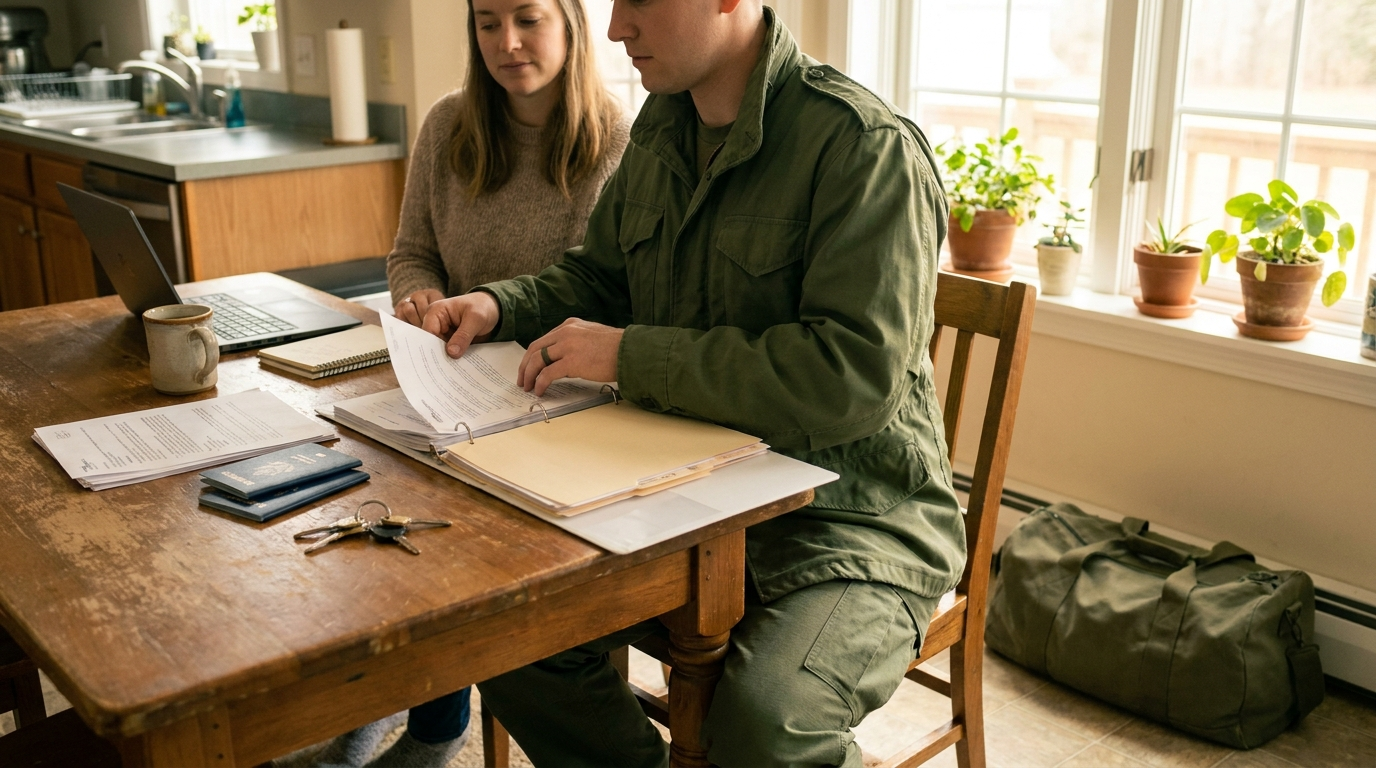
Pre-Deployment Checklist: The Complete 2026 Military Readiness Guide
By the BaseNeed Team — military family resources, updated 2026
A pre-deployment checklist is the single most valuable tool you can build in the weeks before orders send a service member downrange. Deployment day itself is chaos — duffel bags by the door, last hugs, a bus or a flight line at an hour that feels cruel. Everything that makes the following months survivable gets decided before that morning: the powers of attorney signed, the bank accounts set up, the wills notarized, the Family Care Plan filed, the passwords written down. This 2026 pre-deployment checklist walks you through every legal, financial, family, and practical task, organized by timeline, so nothing critical slips through the cracks.
At BaseNeed we've helped thousands of military families move through deployment cycles, and the pattern is always the same: the families who prepare early spend the deployment focused on the mission and on each other, while the families who scramble spend the first month untangling avoidable problems — a frozen bank account, a POA the landlord won't accept, a car registration that lapsed. Use the checklist below to land firmly in the first group.
> Affiliate disclosure: This article contains affiliate links. As an Amazon Associate, BaseNeed may earn a small commission from qualifying purchases at no extra cost to you. We only recommend gear we believe genuinely helps military families prepare.
What Is a Pre-Deployment Checklist and Why It Matters
A pre-deployment checklist is a written, prioritized list of every task a service member and their family must complete before a deployment or extended TDY. It typically spans five domains: legal readiness (powers of attorney, wills, guardianship), financial readiness (allotments, bills, emergency funds), family readiness (childcare, communication plans, the Family Care Plan), administrative readiness (ID cards, DEERS, medical/dental), and personal/home readiness (vehicle storage, home maintenance, mail).
The reason it matters is simple: deployment removes your ability to fix things in person. Once a service member is in a field environment or a combat zone, they may have limited internet, no phone signal for days, and no ability to walk into a bank, a courthouse, or a base legal office. A problem that would take twenty minutes to solve at home can take three weeks — and a lot of expensive phone calls — to solve from 7,000 miles away. A thorough pre-deployment checklist front-loads all of that work while both spouses (or the soldier and their designated caregiver) are still standing in the same kitchen.
Pre-Deployment Checklist Timeline: 90, 60, and 30 Days Out
The best way to attack deployment prep is by working backward from the report date. Trying to do everything in the final week guarantees you'll forget something and stand in three different lines at once. Use this military deployment checklist timeline to spread the work out.
| Timeline | Legal & Administrative | Financial | Family & Home |
|---|---|---|---|
| 90 days out | Book a legal assistance appointment; decide which powers of attorney you need; update or create wills | Build a 3–6 month emergency fund; review all recurring bills; confirm SGLI beneficiaries | Start the Family Care Plan; discuss childcare and school logistics; begin the communication plan |
| 60 days out | Sign and notarize POAs and wills; update DEERS; renew ID cards expiring within a year | Set up allotments in myPay; add spouse/caregiver to accounts; automate bill payments | Schedule car maintenance; plan pet care; hold a family meeting with kids |
| 30 days out | Make copies of every document; confirm the base legal office accepts your POA format | Confirm Savings Deposit Program eligibility; verify pay entitlements start correctly | Stock the home; write "open when" letters; finalize emergency contacts |
| 7 days out | Put originals in a fireproof bag; give the caregiver the document binder | Withdraw a small cash reserve; confirm auto-pay is active | Final vehicle check; sync calendars; test video-call apps |
Print this table, tape it inside a binder, and check items off as you go. The physical act of crossing tasks off is more reliable than trusting your memory during an emotionally loaded season.
Pre-Deployment Checklist: Legal Documents and Deployment Paperwork
Legal readiness is the backbone of any pre-deployment checklist, and it's the area families most often underestimate. The good news: every installation has a legal assistance office (staffed by JAG attorneys) that will draft these documents for you at no cost. Book that appointment early — slots fill fast during deployment surges.
The core legal documents most families need are a general or special power of attorney, a medical power of attorney, a last will and testament, and, where children are involved, guardianship designations. Deployment paperwork also includes updated SGLI beneficiary forms, an updated Record of Emergency Data (DD Form 93), and copies of orders.
A power of attorney (POA) is the document that lets your spouse or a trusted agent act on the service member's behalf. Not all POAs are equal, and using the wrong type causes real problems — many banks and the housing office reject an overly broad "general" POA but accept a narrow "special" one. Here's how the common types compare.
| Power of Attorney Type | What It Authorizes | Best Used For | Watch Out For |
|---|---|---|---|
| General POA | Broad authority over nearly all legal/financial matters | Trusted spouse handling everything | Many banks and lenders refuse it; use sparingly |
| Special (Limited) POA | One specific task (sell a car, sign a lease, manage one account) | Landlords, car sales, single transactions | Must be worded precisely for the task |
| Medical POA | Healthcare decisions for the service member | Emergencies; incapacitation | Separate from financial POA |
| Springing POA | Powers that "spring" into effect on a trigger (e.g., incapacity) | Families wanting limited activation | Proving the trigger can cause delays |
Bring the spouse or caregiver to the legal appointment if possible, and ask the attorney which institutions (your specific bank, the housing office, the DMV) require their own form. For a deeper walkthrough of drafting and using these documents, see our complete military power of attorney deployment guide, which covers exactly which POA to request for each situation.
> Popular pick: A fireproof, water-resistant document bag keeps POAs, wills, birth certificates, and Social Security cards safe and portable for the at-home caregiver. View on Amazon
Financial Readiness: The Pre-Deployment Money Checklist
Money problems are the number-one source of deployment stress, and almost all of them are preventable. Financial readiness on your pre-deployment checklist breaks into three parts: stabilize the household budget, protect access to accounts, and capture the financial benefits of deployment.
Start by building an emergency fund of three to six months of expenses if you can. Then automate every recurring bill — rent or mortgage, car payments, insurance, utilities, phone — through auto-pay so nothing lapses while the service member is unreachable. Make sure the at-home spouse or caregiver is a joint owner (not just an authorized user) on the primary checking account, because ownership is what lets them resolve fraud holds and move money without a POA fight.
Next, set up allotments in myPay so a fixed amount flows automatically to savings or to the caregiver each month. Review your Leave and Earnings Statement (LES) together so both people understand base pay, BAH, BAS, and any special pays. If you want to sanity-check the numbers, our 2026 military pay chart with BAH and BAS breakdowns shows exactly what should be hitting the account.
Deployment also unlocks real financial upside that too many families miss:
- Savings Deposit Program (SDP): Service members deployed to designated combat zones can deposit up to $10,000 and earn a guaranteed 10% annual interest — one of the best risk-free returns anywhere. Set this up as soon as eligibility begins.
- Combat Zone Tax Exclusion (CZTE): Pay earned in a designated combat zone is generally tax-free for enlisted members and warrant officers (and up to a cap for commissioned officers).
- Thrift Savings Plan (TSP): Tax-free combat-zone pay contributed to the TSP grows tax-advantaged. Consider increasing contributions during deployment — see our military TSP guide for the mechanics.
Finally, confirm SGLI coverage and beneficiaries. Servicemembers' Group Life Insurance now offers up to $500,000 in coverage; deployment is the moment to make sure the beneficiary designation reflects your current wishes. Our SGLI life insurance guide explains coverage levels and how to update beneficiaries correctly.
Family Deployment Checklist: Kids, Pets, and the Household
The family side of a deployment checklist is where planning turns into peace of mind. Whether you're a dual-military couple, a single parent, or a spouse holding down the home front, the goal is the same: no single point of failure.
If you have children or other dependents and you're a single parent or dual-military, a Family Care Plan (FCP) is mandatory, not optional. The FCP names a short-term and long-term caregiver, spells out finances and logistics, and includes the powers of attorney that let the caregiver enroll kids in school, seek medical care, and access money. Commanders will ask for it, and an incomplete FCP can delay a deployment or trigger administrative action.
Beyond the formal plan, build a family communication rhythm: agree on how often you'll connect, which apps you'll use, and a backup method for the inevitable comms blackouts. Prepare kids with age-appropriate honesty — a countdown calendar, a map, and a deployment-buddy stuffed animal do more for a five-year-old than any speech. Many families write "open when" letters ("open when you're sad," "open when it's my birthday") that give the deployed parent a presence at home.
Don't forget pets and the physical house. Line up pet care or a sitter, prepay grooming if needed, and leave vet authorization. Walk the house together and note what the at-home spouse needs to know: the water shutoff, the breaker box, the HVAC filter schedule, the lawn service. If you're PCS-ing near or during the deployment window, our PCS binder checklist pairs perfectly with your deployment binder.
> Popular pick: An accordion document organizer or dedicated deployment binder keeps the FCP, POAs, medical records, and account information in one grab-and-go place for the caregiver. View on Amazon
Pre-Deployment Checklist for Spouses
If you're the spouse staying behind, your pre-deployment checklist looks a little different — you're inheriting the whole household. Before the service member leaves, sit down together and make sure you can independently do all of the following: access every financial account in your own name, pay every bill, reach the unit's rear detachment and Family Readiness Group (FRG or the service equivalent), operate and maintain both vehicles, and locate every important document.
Get contact information for the rear detachment (the unit personnel who stay behind) and your installation's Military and Family Life Counseling (MFLC) and Family Readiness staff. Confirm your ID card won't expire mid-deployment and that you're correctly listed in DEERS for TRICARE. Ask for a special power of attorney tailored to the specific things you'll actually need to do — renew the car registration, sign a lease renewal, manage the PCS if one is coming.
Build your own support network now, before you need it. Deployment isolation is real, and the spouses who thrive are the ones who plugged into community early. Explore portable and remote military spouse jobs if you want to use the deployment to build income or a career, and start planning the reunion with our military homecoming ideas guide — having something to look forward to helps.
Pre-Deployment Checklist for Single Soldiers
Single service members without dependents sometimes assume deployment prep doesn't apply to them. It absolutely does — you just have different priorities. Your pre-deployment checklist centers on protecting your stuff and your obligations while you're gone.
Key tasks for single soldiers: give a trusted person (a parent, sibling, or battle buddy) a limited power of attorney; decide what happens to your vehicle (storage, insurance reduction to comprehensive-only, or a POA to sell it); handle your lease or barracks room; forward or hold your mail; and set up auto-pay for every bill so your credit doesn't take a hit. Cancel or pause subscriptions and the gym membership you won't use.
Update your DD Form 93 (Record of Emergency Data) and SGLI beneficiaries so the right people are notified and protected. Store or secure your weapons and valuables legally. If you own a home or have complex finances, get a will. Single soldiers who prep well come home to an intact credit score, a running car, and no ugly surprises — the folks who don't often come home to collections notices and a dead battery.
Army Pre-Deployment Checklist vs. Navy and Air Force
The fundamentals of a pre-deployment checklist are identical across the services, but the terminology, forms, and packing specifics differ by branch. Below is a quick orientation; always defer to your unit's official readiness processing (often called SRP — Soldier/Sailor Readiness Processing) for the authoritative list.
| Branch | Readiness Process | Family Program | Notable Difference |
|---|---|---|---|
| Army | SRP (Soldier Readiness Processing) | Soldier & Family Readiness Group (SFRG) | Heavy CIF gear issue; detailed packing lists per MOS |
| Navy | Individual readiness / IA processing | Fleet & Family Support Center | Sea-duty and IA (Individual Augmentee) deployments differ sharply |
| Air Force | Deployment line / IPR | Airman & Family Readiness Center | Shorter, more frequent rotations for many AFSCs |
| Marines | Pre-deployment readiness (PDRP) | Unit, Personal & Family Readiness Program | Emphasis on field/combat load |
Regardless of branch, the packing side of your prep deserves its own dedicated list. We keep a fully separate, branch-by-branch deployment packing list and checklist so you can hand the admin binder to your spouse and the packing list to yourself.
Deployment Paperwork: What to Copy, Scan, and Store
The last mile of legal and admin prep is documentation logistics. Every critical document should exist in three forms: the original (in a fireproof bag with the at-home caregiver), a physical copy (in the deployment binder), and a secure digital scan (in an encrypted cloud folder both people can reach).
At minimum, copy and scan: orders, all powers of attorney, wills, marriage and birth certificates, Social Security cards, DEERS/TRICARE info, ID cards, vehicle titles and registration, insurance policies (auto, renters/homeowners, SGLI), lease or mortgage documents, immunization/medical records, and a one-page "master information sheet" listing account numbers, logins, and emergency contacts. Store digital copies somewhere both spouses can access, and make sure the caregiver knows the password to the password manager.
This binder becomes the caregiver's command center. When the housing office, the bank, or the school asks for a document at an inconvenient hour, the answer is already in the binder — no frantic 3 a.m. text to a service member who won't see it for a week.
Common Pre-Deployment Checklist Mistakes to Avoid
Even organized families trip over the same avoidable errors. Watch for these:
- Getting a general POA when you needed a special POA. Ask the specific institution what they accept before your legal appointment, or bring a list to the JAG attorney.
- Leaving the spouse as an "authorized user" instead of a joint account owner. Authorized users can't always resolve fraud holds or close/open accounts.
- Forgetting to check ID card and passport expiration dates. A card that expires mid-deployment strands the family without base access or TRICARE proof.
- Skipping the Savings Deposit Program. A guaranteed 10% return on up to $10,000 is free money most eligible members leave on the table.
- No communication plan for blackouts. Agree in advance that silence means operational, not emergency.
- Doing it all in the final week. The last week should be for family, not for standing in the DEERS line.
Avoid these six and you've already outprepared most of the unit.
Key Takeaways
- Start 90 days out and work backward. A pre-deployment checklist spread across three months beats a frantic final week every time.
- Legal first: book the free JAG legal assistance appointment early and request the specific powers of attorney each institution accepts.
- Protect account access and capture benefits: make the caregiver a joint owner, automate bills, and set up the Savings Deposit Program (10% on up to $10,000) and CZTE.
- A Family Care Plan is mandatory for single parents and dual-military families — an incomplete one can delay the deployment.
- Store every document three ways — fireproof original, binder copy, encrypted scan — so the at-home caregiver never gets stuck.
Frequently Asked Questions
How far in advance should I start a pre-deployment checklist? Ideally 90 days before the report date. Legal appointments, document notarization, and financial setup all take time, and slots at the base legal office fill quickly during deployment surges. If you have less notice, prioritize powers of attorney, the Family Care Plan, and joint account access first.
What legal documents do I need before deployment? At minimum: a power of attorney (usually a special/limited POA tailored to specific tasks, plus a medical POA), an updated last will and testament, updated SGLI beneficiary designations, and an updated Record of Emergency Data (DD Form 93). Families with children also need guardianship designations and a completed Family Care Plan. Your installation's legal assistance (JAG) office drafts all of these for free.
What is a Family Care Plan and who needs one? A Family Care Plan (FCP) is a required document for single parents, dual-military couples, and other service members solely responsible for dependents. It names short- and long-term caregivers and includes the powers of attorney, finances, and logistics that let the caregiver act on the family's behalf. Commanders verify it before deployment, and an incomplete FCP can delay or prevent deployment.
Does my spouse need a power of attorney during deployment? In most cases, yes — but choose the type carefully. A narrow special (limited) power of attorney for specific tasks (renewing the car registration, signing a lease, managing one account) is accepted more readily than a broad general POA, which many banks reject. Ask each institution what they require and have the JAG attorney draft accordingly.
How much can I save with the Savings Deposit Program during deployment? Service members deployed to a designated combat zone can deposit up to $10,000 into the Savings Deposit Program (SDP) and earn a guaranteed 10% annual interest, compounded quarterly. That's one of the highest risk-free returns available, so set it up as soon as you're eligible and let it grow for the full deployment.
What to Do Next
- Put a date on the calendar 90 days out (or today, if you're already inside that window) and block time for prep.
- Call the installation legal assistance office and book your powers-of-attorney and will appointment.
- Build your deployment binder — grab a fireproof bag and an organizer, then start filling both the physical and digital copies.
- Hold a family finance meeting: set up allotments, confirm joint account access, and enroll in the Savings Deposit Program the moment you're eligible.
- Complete the Family Care Plan if you have dependents, and share the finished binder with your caregiver.
- Plan the packing separately using our branch-by-branch deployment packing list, and start planning the homecoming — it helps to have something to look forward to.
More From BaseNeed
- Deployment Packing List: The Complete 2026 Checklist for Every Branch
- Military Power of Attorney: The Complete 2026 Deployment Guide
- SGLI Life Insurance: The Complete 2026 Guide
- How to Send a Military Care Package: The 2026 APO/FPO Shipping Guide
- Military Homecoming Ideas: The Complete 2026 Welcome Home Guide
- 2026 Military Pay Chart: Base Pay, BAH, BAS & Allowances
- Plan your move with the BaseNeed PCS checklist and estimate housing with the BAH calculator.
Sources and Resources
- Military OneSource — Deployment Resources and Family Readiness
- Defense Finance and Accounting Service (DFAS) — Savings Deposit Program & Combat Zone Pay
- U.S. Department of Veterans Affairs — SGLI and Servicemembers' Benefits
- American Red Cross — Military Emergency Communication (Hero Care Network)
- IRS — Combat Zone Tax Exclusion and Extensions for the Military
BaseNeed is built by and for the U.S. military community. Bookmark this pre-deployment checklist, share it with your unit's Family Readiness Group, and come home to a household that ran exactly the way you planned it.
Read Full Article on BaseNeed →
Related Deployment guides
- → Family Separation Allowance (FSA): The Complete 2026 Guide to the New $300 Rate and How to Claim It — 13 min read read
- → How to Send a Military Care Package: The Complete 2026 APO/FPO Shipping Guide — 14 min read read
- → Deployment Packing List: The Complete 2026 Checklist for Every Branch — 16 min read read
- → Military Homecoming Ideas: Signs, Outfits, Countdown Traditions & the Complete 2026 Welcome Home Guide — 17 min read read
- → Deployment Gifts: The Ultimate 2026 Guide for Him, Her & Homecoming — 13 min read read
- → Military Power of Attorney: The Complete 2026 Deployment Guide — 13 min read read